
The stories nobody tells
The world is full of inheritances gone wrong. Yet you rarely read about them, because these stories stay locked inside families, buried under shame and the exhaustion of those who lived through them.
Here are a few, told recently by the people who experienced them.
There are orphans who received nothing: when their parents died, relatives took everything. No court, no notary, no lawyer ever returned what was rightfully theirs.
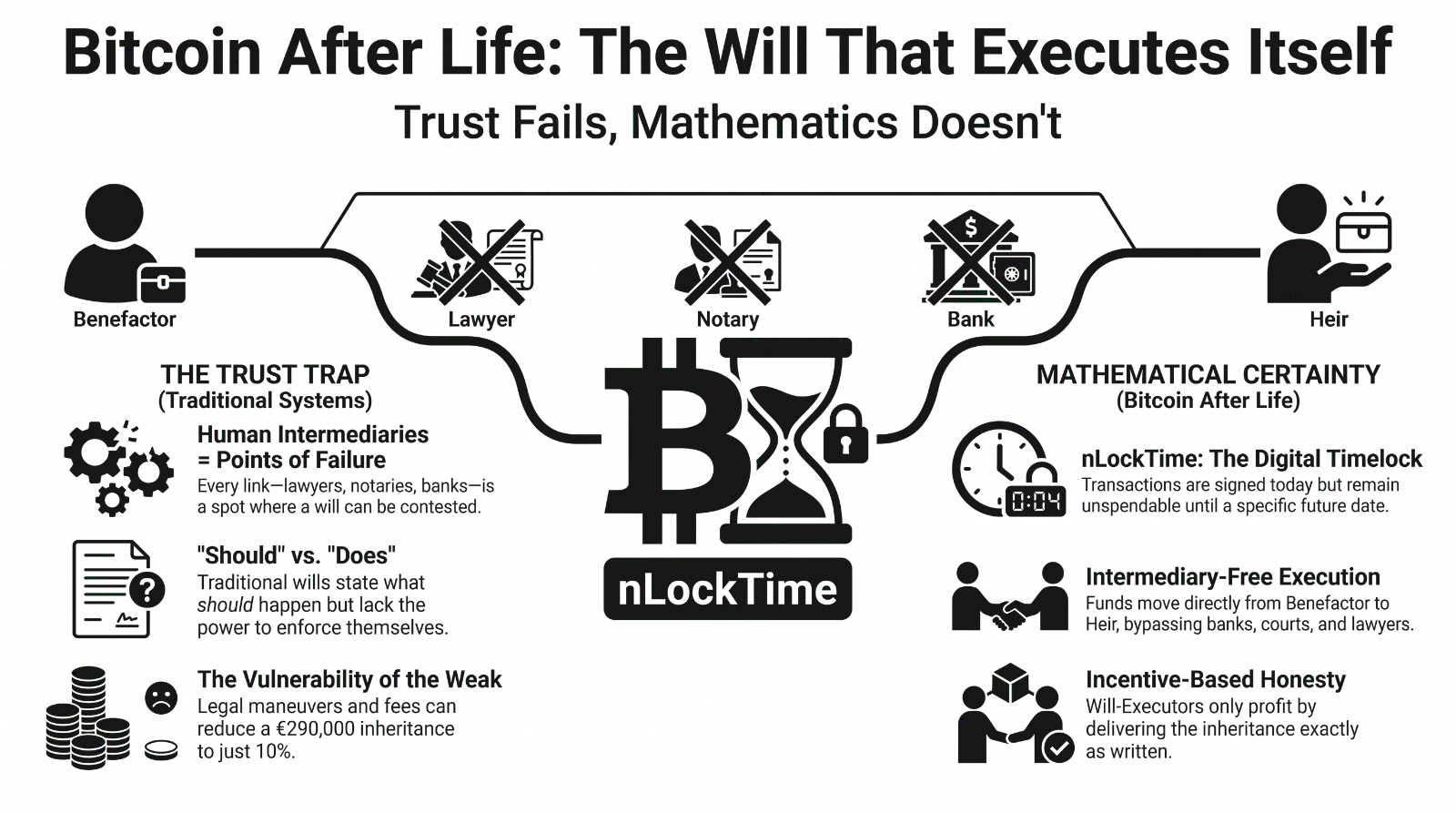
There is a disabled person who had received an inheritance. Then, through lies and lawyers, a sister took almost all of it. An inheritance of €290,000 became, for the disabled heir, €29,000. Ten percent. The rest vanished into legal maneuvers, pressure, and papers signed by someone who lacked the tools to defend himself.
These are not isolated cases. Ask around and you will find that nearly every family has a similar story: the relative who empties the bank account before probate, the brother who "manages" the assets of the weakest, the will contested for years until only legal fees remain.
And the bitterest part is this: the traditional system does not protect the vulnerable. It often exposes them. The orphan, the disabled, the elderly, or simply anyone unfamiliar with the law ends up fighting an unequal battle against those who know the procedures, can afford the best lawyers, and have time on their side.
The problem is human discretion
Why does this happen? Because traditional inheritance passes through a chain of human intermediaries: relatives, executors, notaries, lawyers, banks, courts. Every link in that chain is a point where the will of the deceased can be ignored, distorted, or fought over.
A will is a piece of paper. It says what should happen, but it has no power to make it happen. Between "should" and "does" lies the space where lies, pressure, and lawsuits operate. And in that space, the strongest almost always wins — not the one who is right.
So the question is: is there a way for the will of the person leaving an inheritance to execute itself, without depending on anyone's good faith?
Yes. It has existed since Bitcoin exists.
Bitcoin: an inheritance that lies cannot steal
Bitcoin is mathematical money. Nobody can move your bitcoin without your keys: not a bank, not a court, not a relative with an aggressive lawyer. The rules are not open to interpretation: they are verified by thousands of nodes around the world and apply equally to everyone.
This radically changes the inheritance problem. With Bitcoin, the question is no longer "who will prevail in front of a judge?" but "what did the owner decide, while alive?".
Bitcoin has a native, little-known feature designed precisely to program the future: the timelock (nLockTime). It lets you sign a transaction today that becomes valid only after a certain date. A kind of letter to the future, sealed by cryptography: nobody can open it early, nobody can change its contents, and when the moment comes it executes exactly as written.
This is the foundation of Bitcoin After Life.
Bitcoin After Life: the will that executes itself
Bitcoin After Life (B.A.L.) is an open-source protocol created to solve exactly this problem: leaving your bitcoin as inheritance without intermediaries — no notaries, no human executors to trust, no third parties who can interfere.
In simple terms, it works like this:
- You decide, while alive. With a plug-in for the Electrum wallet, you prepare a transaction that assigns your bitcoin to your heirs — children, spouse, whoever you choose, in whatever proportions you choose.
- The transaction carries a future date. Thanks to the locktime, the transaction is signed today but becomes spendable only after the date you set. Until then, the bitcoin remains yours, under your full control.
- While you live, you renew. Periodically you move the funds or update the transaction, pushing the date forward. It is your "I'm still here." You can change your mind anytime: add an heir, remove one, adjust the shares. Nobody has to authorize you.
- If you pass away, mathematics does the rest. The signed transaction is held by one or more Will-Executors: independent servers that broadcast it to the Bitcoin network when it expires. They cannot modify it, cannot steal it, cannot censor it: they can only transmit it as-is. Their reward is a fee included in the transaction itself, which they receive only when the inheritance actually reaches its destination.
That last point is the heart of the protocol: incentives. Drawing on John Nash's game theory — the same logic of incentives Bitcoin itself is built on — B.A.L. asks nobody to be honest out of kindness. It makes honesty the only profitable strategy. The Will-Executor earns only by delivering the inheritance exactly as the owner wrote it. Anyone can run a Will-Executor, because the code is open source: the more there are, the more robust the system.
And it is not only for inheritance: the same mechanism works as a backup in case of key loss, and as a safety net for multi-signature wallets.
What would have changed for those people
Back to the stories from the beginning.
The orphans whose relatives took everything: had that estate been in bitcoin with a B.A.L. transaction in their favor, the relatives could not have touched a thing. There is no account to empty, no house to transfer, no signature to extort. At expiry, the funds go to the designated heirs. Period.
The disabled heir robbed of 90% by his sister: no lie and no lawyer can argue with a Bitcoin transaction. €290,000 would have remained €290,000 (or more, given bitcoin's historical trajectory). The sister could have hired every lawyer in the world: the Bitcoin network does not listen to lawyers. It executes rules.
This is the difference between a system based on trust and one based on verification. The first works as long as everyone behaves. The second works always.
Sovereignty, not anarchy
An important clarification: none of this means circumventing the law.
Bitcoin After Life establishes who receives what, with certainty and beyond manipulation. Then each heir, sovereignly, will do with the inheritance whatever they choose — including complying with the tax rules of their country of residence: inheritance declarations, taxes due, legal obligations. The technology replaces neither the tax authority nor succession law; it guarantees that the will of the deceased arrives at its destination intact, instead of dissolving along the way.
The difference is subtle but fundamental. In the traditional system, people first fight for years over who gets what, and whatever remains gets taxed. With B.A.L., the "who gets what" is decided by mathematics; what remains for each person are simply their duties as a citizen, which they can fulfill in peace, with no lawyers at their heels.
Conclusion: protecting those who cannot defend themselves
Inheritances gone wrong all share one element: someone took advantage of a person who could not defend themselves. Orphans, the disabled, the elderly. The current system, with all its courts and professionals, failed to protect them — worse, it was the very instrument used to strip them.
Bitcoin offers an alternative that requires trusting no one. And Bitcoin After Life makes it practical: a will written in mathematics, which no lie can rewrite and no lawyer can contest.
Those who want to dig deeper will find the Electrum plug-in, instructions, and practical examples at bitcoin-after.life. The code is open source, verifiable by anyone.
Your will deserves to be executed. Not debated.
This article is for informational purposes only and does not constitute legal or tax advice. For your own estate and tax situation, consult a professional in your country of residence.